What the 2026 Verizon Data Breach Investigations Report Means for Your Business
Every year, Verizon releases one of the most comprehensive cybersecurity studies in existence — the Data Breach Investigations Report (DBIR). Now in its 19th edition, the 2026 DBIR analyzed more than 22,000 confirmed data breaches from 145 countries, making it the largest dataset the report has ever examined.
If you lead a business — whether you have 10 employees or 1,000 — this report has direct implications for how you protect your organization. Here's what you need to know, without the technical jargon.
The Threat Landscape Is Changing Fast — And Getting More Dangerous
Attackers Are Exploiting Unpatched Systems at Record Rates
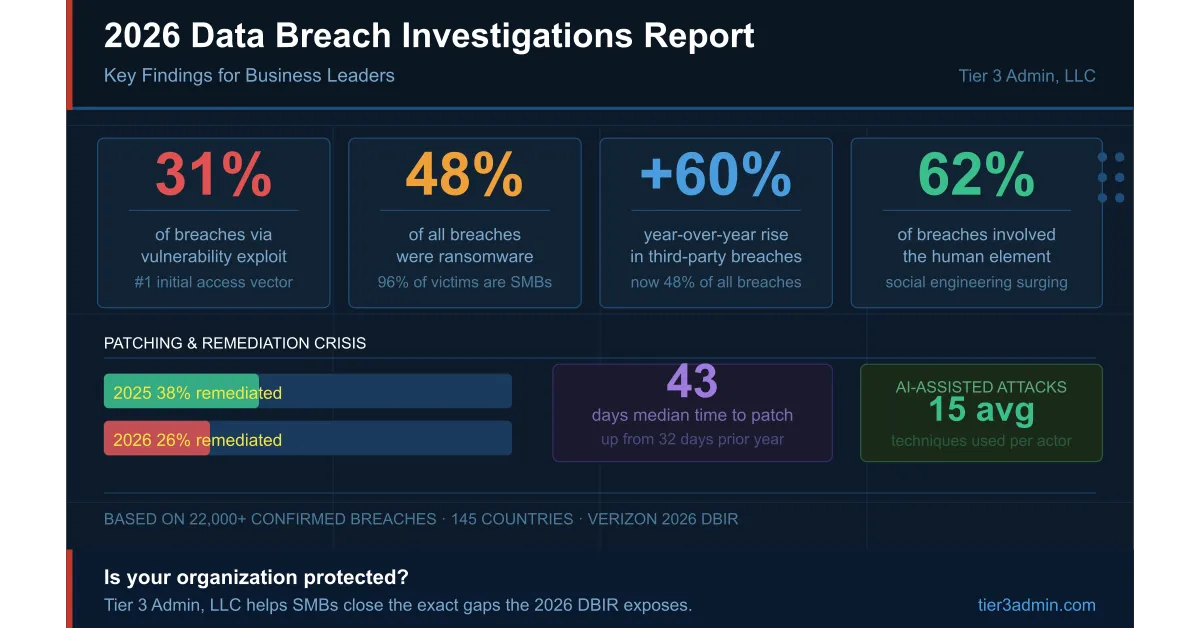
For the first time, exploitation of software vulnerabilities has become the #1 method attackers use to break into organizations, rising to 31% of all breaches. This surpassed credential theft, which had held the top spot for years.
What makes this particularly alarming for businesses is the patching gap: only 26% of critical, actively exploited vulnerabilities were fully remediated in 2025 — a sharp drop from 38% the year before. The median time to fully patch a known critical vulnerability stretched to 43 days, up from 32 days in the prior year.
To put that in plain terms: when a known vulnerability is made public and added to the government's critical watch list, most organizations are leaving themselves exposed for over a month. Attackers don't wait that long.
What this means for you: If your business isn't running a consistent, prioritized patch management program, you are statistically likely to have open doors that attackers know about and are actively targeting.
Ransomware Is Now the Dominant Threat — and SMBs Are the Primary Target
Ransomware grew to 48% of all breaches in 2026, up from 44% the year before. While some good news exists — 69% of victims chose not to pay the ransom and median ransom payments are trending down — the volume of attacks is still growing rapidly.
The most important finding for small and mid-sized business owners: 96% of ransomware victims were small or medium-sized businesses. This isn't a Fortune 500 problem. Ransomware operators cast wide nets, and they're looking for the same things in every organization: unpatched systems and compromised credentials. The size of your business or your industry doesn't protect you.
What this means for you: Every business needs a ransomware response plan. Backups, endpoint protection, and employee training aren't optional extras — they're the minimum standard.
Your Vendors and Partners Are Now a Major Risk
Third-party involvement in breaches jumped 60% year-over-year, now present in 48% of all confirmed breaches. In other words, nearly half of all data breaches trace back to a vendor, software provider, or service partner — not a direct attack on the organization itself.
Some of the most high-profile breaches of the past year involved attackers compromising multiple third-party providers simultaneously to access their downstream clients. If your vendor gets breached, your data may be exposed — even if your own internal systems are perfectly secure.
The report also found that only 23% of third-party providers had fully remediated known security gaps in their cloud accounts, with weak passwords and permission misconfigurations taking an average of eight months to resolve at the median.
What this means for you: Vendor security is your security. Understanding who has access to your data and systems — and whether those vendors meet a security baseline — is now a business-critical function.
Artificial Intelligence Is in the Hands of Attackers
Generative AI has officially crossed from theoretical risk to operational reality for cybercriminals. The 2026 DBIR found that threat actors are actively using AI tools to accelerate and scale attacks — from researching targets and crafting convincing phishing messages to developing and deploying custom malware.
The median attacker used AI assistance across 15 documented attack techniques, with some leveraging AI across 40 to 50 techniques in a single campaign.
On the inside, Shadow AI — employees using unauthorized AI tools on company devices — has become a top data loss risk. Currently, 67% of users access non-corporate AI accounts on company devices, and 45% of employees are now considered regular AI users on corporate devices (up from 15% just a year ago). The most common type of data uploaded to unauthorized AI systems? Source code — followed by images and proprietary business data.
What this means for you: You need an AI use policy. Without clear guidelines and enforcement, your employees may be inadvertently feeding sensitive company data into external AI systems with no visibility or control on your end.
People Are Still the Most Exploited Asset in Your Organization
The human element was present in 62% of breaches — a slight increase from the prior year. Social Engineering attacks, including phishing and the increasingly common tactic of pretexting (where attackers build fake trusted relationships over time before striking), now represent 16% of all breaches.
One of the most striking findings: mobile-based social engineering attacks — voice calls and text messages — have a 40% higher success rate than email phishing. As your employees become more skeptical of email scams, attackers are shifting to channels where people are less guarded.
Pretexting in particular is fueling ransomware campaigns. Unlike a simple phishing email, pretexting involves an attacker engaging in real-time conversation — by phone, text, or email — to manipulate an employee into taking an action that opens a door into your network. Standard email phishing training doesn't prepare employees for this type of attack.
What this means for you: Security awareness training needs to evolve beyond "don't click bad links." Employees need to know how to recognize and respond to voice-based manipulation, impersonation calls, and multi-step social engineering attempts.
The Five Fundamentals That Still Matter Most
The 2026 DBIR is clear on one overarching message: the fundamentals of cybersecurity remain the most powerful defense. The organizations that fared best share these characteristics:
1. Consistent patch management. Critical vulnerabilities are patched quickly — ideally within days, not weeks or months.
2. Multi-Factor Authentication (MFA) everywhere. Credential theft drives a significant portion of attacks. MFA, properly deployed, stops the vast majority of credential-based intrusions.
3. Third-party risk management. Knowing which vendors have access to your data and holding them to security standards protects you from breaches you can't directly control.
4. Ongoing security awareness training. Employees who can recognize phishing, pretexting, and social engineering are one of your best defenses.
5. A tested incident response plan. When (not if) an incident occurs, the difference between a contained incident and a catastrophic breach often comes down to how fast and how effectively your team responds.
How Tier 3 Admin, LLC Can Help
At Tier 3 Admin, we work exclusively with small and mid-sized businesses to build practical, effective cybersecurity programs grounded in exactly what the DBIR recommends. We understand that SMBs face the same threats as large enterprises, often with a fraction of the IT resources.
Our services address the exact vulnerabilities the 2026 DBIR highlights:
Vulnerability & Patch Management — We identify and close the gaps attackers look for, with prioritized remediation aligned to CISA KEV and industry best practices.
MFA Deployment & Identity Security — We implement and manage multi-factor authentication across your entire environment so stolen credentials stop being a viable attack vector.
Vendor & Third-Party Risk Review — We assess the security posture of your critical vendors and help you establish standards for third-party access.
Security Awareness Training — We go beyond email phishing simulations to prepare your team for voice-based attacks, pretexting, and modern social engineering.
Incident Response Planning — We build and test response playbooks so your team knows exactly what to do when an incident occurs.
The 2026 DBIR is a wake-up call. But it also makes clear that the solutions exist — and they work. Organizations that apply the fundamentals consistently are far better positioned to withstand today's threat landscape.
Ready to Find Out Where Your Organization Stands?
We offer a no-pressure security assessment to help you understand your current risk posture and identify the highest-priority areas to address. There's no obligation — just clarity.
Contact Tier 3 Admin, LLC today to schedule your assessment.
📧 Reach us at 740.990.2553 or visit our website to learn more.
📖 Read the full 2026 Verizon Data Breach Investigations Report: 2026 Verizon DBIR: Breakthroughs in vulnerabilities, AI-assisted cyber attacks and social engineering
Source: Verizon 2026 Data Breach Investigations Report. Statistics and findings cited in this article are drawn directly from the 2026 DBIR dataset covering incidents from November 1, 2024 through October 31, 2025.