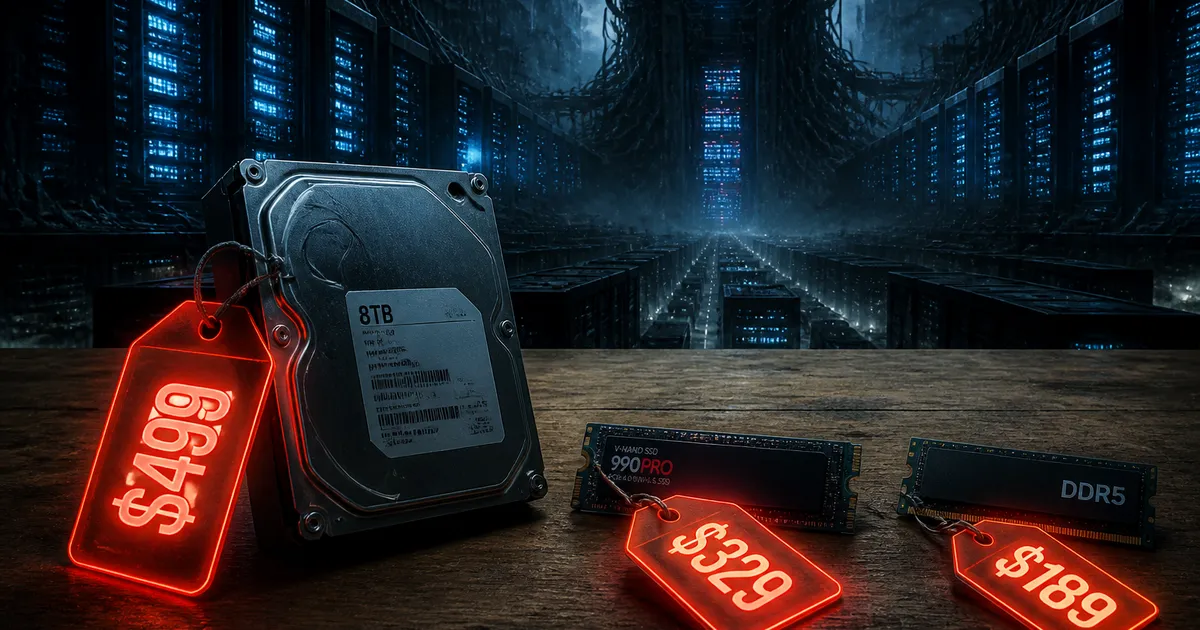
The AI Tax: How Artificial Intelligence Set Consumer Computing Back 20 Years
If you are an IT professional, a system builder, or an MSP trying to quote a project today, you already know the punchline: the cost of basic computing components has gone backwards. Not slightly. Not incrementally. We are talking about price levels that would have looked extreme in 2010, let alone 2024.
This is not a supply-chain hiccup. It is not a cyclical memory boom. It is a structural repricing of the entire component stack, driven by AI data center demand, and there is no credible evidence that relief is coming before the end of the decade.
The Hard Drive Is Not Hard to Find — It Is Just Hard to Afford
In early 2025, a 4TB NAS-grade hard drive was a reasonable purchase. The WD Red Plus 4TB, a staple of small business storage and home lab builds, historically averaged around $93 according to price-tracking data [1]. As of July 2026, Amazon's own stock is inconsistent, and current listings from major retailers range from roughly $195 to $257 for the same drive [2]. That is not a tariff. That is not a currency fluctuation. That is a commodity product running well over double its historical price.

The 8TB market is worse. The WD Red Plus 8TB and WD Black 8TB are both selling well north of $350 [2]. On Reddit's DataHoarder community, users have documented enterprise-class drives jumping in price within a single month as allocations tighten [3].
As an MSP, you cannot eat these costs. You have to pass them to clients. And clients are not used to being told that their file server refresh costs more than twice what it did two years ago.
Why is this happening? Because the manufacturers have stopped pretending the consumer market matters.
Western Digital CEO Irving Tan said on his company's Q2 2026 earnings call that the company is "pretty much sold out for calendar 2026," with firm purchase orders in place with its top seven customers, and noted that long-term agreements are already established with two customers for calendar 2027 and one for calendar 2028 [4]. Seagate CEO Dave Mosley has been equally direct: nearline HDD capacity is fully booked through 2026, with the vast majority of exabytes already allocated into 2028 under long-term agreements [5]. Seagate shipped 199 exabytes in a recent quarter, with cloud and data center customers accounting for 88% of those exabyte shipments and 80% of quarterly revenue [6].
The hard drive you need for your client's backup server is now competing with training datasets. And the training datasets are winning.
SSDs: From Cheap to Boutique
If HDDs are bad, SSDs are worse. The NAND flash market has been almost entirely reoriented around enterprise AI workloads.
In 2024, a tech reporter at The Verge paid $173 for a WD Black SN850X 2TB NVMe SSD. As of mid-2026, that same drive is running $370 to $445 depending on retailer [7] — still more than double its 2024 price. A 2TB NVMe SSD that averaged $168.75 in early 2025 now averages $357.50, a 113.7% increase according to GamersNexus price tracking [8].
The Crucial P310 1TB SSD was $55.99 on Amazon in January 2025. It peaked at $312.40 in May 2026 and still sits around $175 as of July 2026 [9]. A 1TB boot drive that was impulse-buy territory is now a budget-line item.
At the high end, the numbers are absurd. DriveVault reported a 30TB enterprise TLC SSD that cost roughly $3,062 in mid-2025 now costs approximately $11,000 — a 257% increase [10]. Kingston has reported a steep rise in NAND wafer costs. Contract prices for NAND chips have surged more than 600% since September 2025, with DRAM contract prices up nearly 400% over the same period, according to Bloomberg-sourced industry data [11].
Hybrid SSD-plus-HDD deployments are now the only financially sane approach for many businesses, and even that is only "sane" in relative terms [12].
RAM: The Component That Broke the Budget
If you build workstations or quote server memory, you have already seen the invoices. A 32GB DDR5-6000 kit that cost $75 to $95 in mid-2025 now runs $400 to $470, if you can find it [13]. A 32GB kit that was $104.99 in 2024 is now well over $350 after a so-called "price drop" [14].
YouTuber and developer Jeff Geerling documented a 64GB DDR5 kit he purchased for $209 earlier in 2025. The exact same SKU now costs $650 [15]. That is not inflation. That is a market failure.
The memory market is being cannibalized by High Bandwidth Memory (HBM) production. The same DRAM wafers that used to become your DDR5 modules are now being diverted into HBM stacks for AI accelerators. Data centers are projected to consume 70% of memory chips produced worldwide in 2026, up from roughly 20-30% as recently as 2022 [16]. HBM is not just a different product line — it is actively consuming the manufacturing capacity that once fed the commodity DRAM market [17].
This Is Not a Cycle. It Is a Structural Shift.
The most dangerous assumption in IT budgeting right now is that this is a temporary spike. That assumption is wrong.
Industry analyst George Crump has argued that most IT leaders are treating the 2025-2026 price spike like every memory shortage of the last twenty years — wait 12 to 18 months, watch manufacturers expand capacity, ride the price collapse back down. That playbook, Crump contends, is dead [18].
Crump's reasoning is simple and brutal. New fabrication facilities take years to bring online. The output from newly announced fabs is largely committed to AI buyers before it even ships, and most analysts now expect gradual relief starting in 2027 at the earliest, with broader normalization — at a higher baseline than pre-2025 pricing — not arriving until 2028 or 2029 [18].
Samsung and SK Hynix have jointly committed roughly $500 billion to new memory fab capacity [19]. Worth noting: the two companies have since announced an even larger, roughly $518 billion, four-fab expansion in South Korea — and that newer project isn't targeted for completion until the mid-2030s, later than earlier capacity announcements suggested [20]. Samsung's HBM equipment installs at its Onsang facility are scheduled for 2027, with wafer output from Pyeongtaek not coming until 2028 to 2029 [21].
Micron is expanding in the U.S. with a roughly $200 billion investment (recently increased to more than $250 billion through 2035), but those facilities will take years to reach volume production [22].
In the hard drive world, the situation is arguably more dire because there are only three manufacturers left, and Seagate's leadership has signaled that building new factories would take too long to meaningfully address current demand [23]. Seagate's nearline capacity is reportedly allocated well into 2027 and 2028 [24].
The Counterargument: What If the Bubble Bursts?
There is one dissenting voice worth taking seriously. Seeking Alpha published an analysis arguing that massive DRAM supply expansions and inventory overbuilds will likely trigger a sharp reversal in chip prices, predicting DRAM prices could drop 80% to 90% within three years [25].
The logic is not crazy. Memory markets have historically overshot. When the crypto mining boom ended, GPUs crashed. When the 2017-2018 DRAM shortage ended, prices collapsed. If AI demand slows — if the VC-funded data center buildouts hit a wall — manufacturers could be left with enormous capacity and no buyers.
But there is a critical difference this time. The previous shortages were driven by cyclical demand: smartphones, crypto, cloud growth. Those were markets where demand could pause. AI infrastructure spending is being locked in through multi-year, firm purchase agreements. Western Digital and Seagate are not selling into a spot market; they are pre-selling years of capacity to cloud hyperscalers. That makes the demand stickier and the supply more constrained.
Morgan Stanley's analysts have noted that under their most optimistic pricing scenario, earnings for both Seagate and Western Digital could increase roughly tenfold between 2025 and 2028 — well above their base case, which already sits about 70% above prior Street consensus [26]. That is not a forecast built on an assumption of a crash.
What the Next 3-5 Years Actually Look Like
So, will prices ever come back down? The honest answer is: not to where they were.
Here is the timeline the data supports:
2026-2027: Continued increases or sustained highs. TrendForce has tracked client SSD contract prices rising at least 40% quarter-over-quarter, with some categories — enterprise SSDs and NAND flash broadly — seeing even steeper increases through 2026 [27]. IDC warns memory supply challenges will persist through 2027 [28].
2028: First possible meaningful relief. New NAND and DRAM capacity begins coming online. But that output is largely committed to AI buyers before it ships. Consumer relief, if any, would be modest.
2029-2030: Best-case scenario for a return to something resembling 2024 pricing. And that is the optimistic case. The pessimistic case, voiced by multiple analysts, is that this is simply the new normal — a return to "normal" by 2030 may itself be too optimistic [18].
The reason is structural. AI data centers are not just buying more storage and memory. They are signing open-ended purchase agreements at premium prices that price out everyone else. Anthropic's deal to ramp to full utilization of xAI's Colossus 1 data center — a SpaceX-brokered compute arrangement reportedly worth $1.25 billion a month — is a clear example: that capacity is not coming back to the consumer market. The long-term agreements that WD and Seagate are signing for 2027 and 2028 are not one-time events; they are the new business model.
What MSPs and IT Buyers Should Do
If you are quoting projects now, stop pretending this is temporary. Budget for elevated component costs through at least 2028. Architect around hybrid storage. Consider refurbished or secondary-market memory where appropriate. Pool resources. And be honest with clients: the days of cheap, abundant storage and memory are not coming back on a timeline that helps anyone currently in business.
We are not in a shortage. We are in a repricing. And the repricing is being written by people who do not know or care what a small business NAS costs.
Sources
[1] Pangoly — WD Red Plus 4TB Price History: https://pangoly.com/en/price-history/western-digital-red-plus-4tb
[2] Tom's Hardware — Best Hard Drive Deals (Amazon/Newegg): https://www.tomshardware.com/pc-components/hdds/best-hard-drive-hdd-deals-amazon
[3] Reddit r/DataHoarder — HDD Price Increases: https://www.reddit.com/r/DataHoarder/comments/1r9d2jx/these_hdd_prices_are_getting_crazy_an_increase_of/[4] Tom's Hardware — Western Digital sold out of hard drives for all of 2026: https://www.tomshardware.com/pc-components/hdds/western-digital-is-already-sold-out-of-hard-drives-for-all-of-2026-chief-says-some-long-term-agreements-for-2027-and-2028-already-in-place
[5] TrendForce — Seagate Q3 Guidance Tops Estimates, Nearline HDD Capacity Fully Booked Through 2026: https://www.trendforce.com/news/2026/01/28/news-seagate-q3-guidance-tops-estimates-nearline-hdd-capacity-fully-booked-through-2026/
[6] Blocks & Files — Seagate Q3 FY26 results / exabyte shipments: https://www.blocksandfiles.com/disk/2026/04/29/spinning-disks-generating-massive-revenue-for-seagate/5219028
[7] Slashdot — AI RAM Shortage Driving Up SSD Prices: https://hardware.slashdot.org/story/26/04/11/0539235/the-ai-ram-shortage-is-also-driving-up-ssd-prices
[8] GamersNexus — SSD Price Tracking: http://gamersnexus.net/features/ssds-wtf
[9] Pangoly / CamelCamelCamel — Crucial P310 1TB Price History: https://camelcamelcamel.com/product/B0D61Z8R1W
[10] DriveVault — Hard Drive Price Surge 2026: https://www.drivevault.io/blog/hard-drive-price-surge-2026.html
[11] TechSpot — NAND contract prices surge over 600% since September 2025, DRAM up ~400%: https://www.techspot.com/news/112398-nand-contract-prices-surge-over-600-since-september.html
[12] Tom's Hardware — Hybrid SSD-HDD Deployments Cheaper: https://www.tomshardware.com/pc-components/storage/ssds-now-cost-16x-more-than-hdds-hybrid-ssd-hdd-datacenter-deployments-are-now-significantly-cheaper-to-deploy-than-ssd-only-equivalents
[13] Tom's Hardware — RAM Price Index 2026: https://www.tomshardware.com/pc-components/ram/ram-price-index-2026-lowest-price-on-ddr5-and-ddr4-memory-of-all-capacities
[14] YouTube — RAM Price Comparison: https://www.youtube.com/watch?v=0jCMF7OeH9w
[15] Jeff Geerling — The RAM Shortage Comes For Us All: https://www.jeffgeerling.com/blog/2025/ram-shortage-comes-us-all
[16] Tom's Hardware — Data centers to consume 70% of memory chips made in 2026: https://www.tomshardware.com/pc-components/ram/data-centers-will-consume-70-percent-of-memory-chips-made-in-2026-supply-shortfall-will-cause-the-chip-shortage-to-spread-to-other-segments
[17] Medium — Memory Supercycle: HBM Hunger Squeezing DRAM: https://medium.com/@Elongated_musk/memory-supercycle-how-ais-hbm-hunger-is-squeezing-dram-and-what-to-own-79c316f89586
[18] Storage Switzerland (George Crump) — Memory and Flash Prices Are Not Coming Down: https://storageswiss.com/2026/05/06/memory-and-flash-prices-not-coming-down/
[19] Yahoo Finance — Samsung, SK Hynix to Spend $500 Billion Building More RAM Fabrication Capacity: https://finance.yahoo.com/technology/articles/samsung-sk-hynix-spend-500-185236692.html
[20] Tom's Hardware — South Korea unveils $520 billion investment plan with Samsung and SK Hynix: https://www.tomshardware.com/tech-industry/semiconductors/south-korea-unveils-usd520-billion-investment-plan-with-samsung-and-sk-hynix-to-expand-memory-chip-dominance-plan-includes-four-new-fabs-and-hbm-facilities-amid-strong-government-support
[21] X/Twitter (MilkRoadMacro) — Samsung HBM Equipment Timeline: https://x.com/MilkRoadMacro/status/2074485446584005038/photo/1
[22] Micron — US Expansion: https://www.micron.com/us-expansion
[23] Reddit r/business — Seagate CEO comments on new factory timelines: https://www.reddit.com/r/business/comments/1th1hgf/seagate_leads_memory_selloff_as_ceo_dave_mosley/
[24] TrendForce — Seagate nearline capacity allocation: https://www.trendforce.com/news/2026/01/28/news-seagate-q3-guidance-tops-estimates-nearline-hdd-capacity-fully-booked-through-2026/
[25] Seeking Alpha — DRAM Prices Likely to Drop 80-90% in 3 Years: https://seekingalpha.com/article/4920140-dram-prices-likely-to-drop-80-90-percent-in-3-years
[26] 24/7 Wall St. / Morgan Stanley — Seagate and Western Digital hit record highs: https://247wallst.com/investing/2026/06/16/western-digital-jumps-7-on-morgan-stanleys-33-price-target-hike-seagate-gains-5-as-the-ai-storage-boom-rolls-on/
[27] TrendForce — Memory Price Outlook for 1Q26 Sharply Upgraded: https://www.trendforce.com/presscenter/news/20260202-12911.html
[28] IQON Digital — When Will RAM Prices Drop 2026 Forecast: https://iqondigital.com/learn/pc-news/when-will-ram-prices-drop-2026-forecast